How much does a wrap around extension cost?
Updated 6 October 2026 · prices for 2026
Typical cost of a single-storey wrap around extension
£44,190–£67,980
for 18 to 40 m² (outside size), shell and finishes inside, including VAT (£36,820–£56,650 + VAT)
Foundations, floor, walls, a flat EPDM roof with a lantern, French doors, a 4.5 m knock-through with steels, plastering, electrics and decorating. Kitchen, floor coverings, heating and fees are extra.
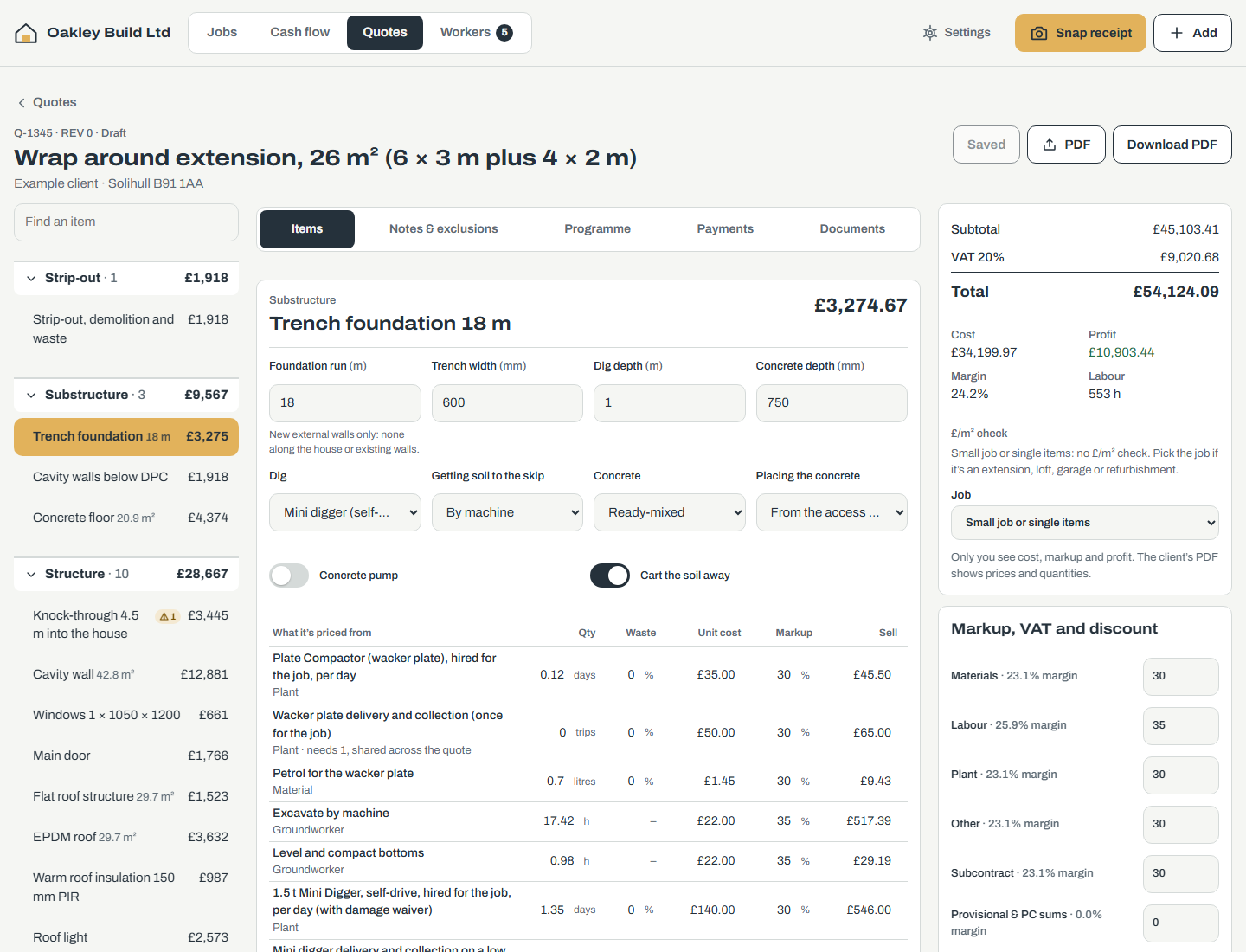
A single-storey wrap around extension costs about £44,000 to £68,000 including VAT in 2026 (£36,821 to £56,654 before VAT) for 18 to 40 m², measured outside. A typical one, 6 × 3 m across the back and 4 × 2 m down the side, about 26 m², comes to about £54,124 including VAT (£45,103 before VAT), or about £1,735 a m² before VAT. That's built, plastered, wired and decorated, with a knock-through into the house.
A wrap around is an L-shaped extension. It goes across the back of the house and turns the corner down the side, usually into the side passage. You get a wide room at the back and the side part for a dining area, utility or a bigger kitchen.
What's in the price
We priced the 26 m² example with new walls on three sides, a flat EPDM roof and a 4.5 m opening into the house. This is where the money goes, before VAT.
- Foundations: 18 m of trench, 600 × 1000 mm, dug by mini digger and filled with C25 ready-mix, £4,303, and the cavity walls up to the DPC, £1,918.
- The floor: 20.9 m² inside the walls, hardcore, DPM, 120 mm PIR, mesh, concrete and a 75 mm screed, £5,020.
- Walls: 42.8 m² of cavity wall, brick outside (about 2,539 bricks at a £1.77 allowance) and block inside, with 100 mm PIR in the cavity, £12,881.
- The roof: 29.7 m² of joists, OSB deck, 150 mm PIR and EPDM, £6,143, plus fascia, soffit and gutters, £1,197.
- Glazing: a 3.0 × 1.0 m roof lantern, £2,573, aluminium French doors 1.3 m wide, £1,766, and one uPVC window, £661.
- The knock-through: propping, opening a 4.5 m cavity wall, two steels (UB 305×165×40 in our example: the engineer sizes them) and making good, £3,687.
- Inside: dry lining and skim, ceilings, skirting and decorating, £3,812, and electrics, £1,140.
That's about 553 hours of work in all. The walls are the biggest single item, more than a quarter of the price.
Price by size
- 18 m² (5.5 × 2.5 m plus 3 × 1.5 m): £36,821 before VAT, £44,186 including VAT
- 26 m² (6 × 3 m plus 4 × 2 m): £45,103 before VAT, £54,124 including VAT
- 40 m² (7 × 4 m plus 5 × 2.5 m): £56,654 before VAT, £67,985 including VAT
All single storey with a flat roof, one lantern, French doors, one window and a knock-through. Not included are the kitchen, floor coverings, heating, drainage changes, scaffold, and the architect, engineer and building control fees.
Pricing it as a builder
Price a wrap around as two boxes that share a corner. The rear part's length runs across the house and the side part, so the corner is counted once. Then the foundations go under the new walls only, the floor and roof by area, and the walls by m² less the openings. The knock-through and its steels are their own item, and the steel sizes stay provisional until the engineer's calculations are in.
Check these on the site visit. Whether the side part sits on the boundary, because that brings in a party wall notice and usually a parapet and box gutter. Where the drains run, because the side passage often has a manhole in it. How you'll get a digger and the ready-mix lorry in, and where the spoil goes. And what's in the walls you're opening, such as a kitchen, a back door or a window, because taking those out is extra.
Priced on its own, a job like this carries a small premium for travel, setting up, a minimum charge and part-used materials. Done as an extra while you're already on site, the same work usually costs a bit less.
How we priced it
We built the job in Bricken, the quoting app for UK builders, with its extension starter, item by item. Standard merchant prices for the materials, a £1.77 allowance per brick, typical hourly rates for each trade, and a typical builder's markup of 30% on materials and 35% on labour. Your builder will price it at their own rates, so get a few quotes.
Priced in Bricken at standard UK rates (18 m² for the low figure, 40 m² for the high). Each figure is then multiplied by Bricken's regional factor, from 0.90 in the North East to 1.30 in inner London. The factors come from public 2025-26 build-cost guides and our own quotes. Where a region covers two areas, the low uses the lower factor and the high the higher. Treat small differences as a guide.
Cost by region
| Region | 18 m² | 40 m² |
|---|---|---|
| London | £53,020£44,186 | £88,380£73,650 |
| South East | £49,490£41,240 | £76,140£63,452 |
| East of England | £46,390£38,662 | £71,380£59,487 |
| Midlands | £42,860£35,717 | £67,980£56,654 |
| North West | £41,980£34,980 | £64,590£53,821 |
| North East and Yorkshire | £39,770£33,139 | £64,590£53,821 |
| South West | £46,390£38,662 | £71,380£59,487 |
| Wales | £40,650£33,876 | £62,550£52,122 |
| Scotland | £44,190£36,821 | £67,980£56,654 |
What pushes the price up or down
Up
- The knock-through: a 4.5 m opening into the house with two steels adds £3,416 before VAT to our 26 m² job.
- Bifolds instead of French doors: 3 m aluminium bifolds add £728 on the same job, after the wall they replace.
- A boundary wall: if the side part is built on the boundary, a parapet and box gutter, and a party wall notice, come into it.
- Difficult ground or deep foundations: our price is for 1 m deep trenches dug by mini digger.
- Drains under the footprint: moving a drain or building over one is extra.
- London prices: about 20% to 30% more, from Bricken's regional factors.
Down
- Building the rear part only: a 6 × 3 m rear extension with the same knock-through is £34,101, so the side part is about £11,002 of our typical price.
- Bigger extensions cost less a m²: about £1,399 a m² at 40 m² against £2,018 at 18 m², before VAT.
- Leaving the existing walls alone: no knock-through takes our 26 m² job to £41,688.
- Supplying your own doors, lantern or bricks: the builder then prices fitting only.
Questions
How long does a wrap around extension take to build?
Our 26 m² job has about 553 hours of work in it, around 69 working days for one person. With a crew of three that's about four and a half weeks of work, and longer on site while you wait for concrete to cure, plaster to dry and the doors and lantern to arrive.
Do I need planning permission for a wrap around extension?
Often, yes. Permitted development has separate limits for side and rear extensions, and a wrap around has to meet both. The Planning Portal says a side extension can only be single storey and up to half the width of the original house. Check with your council before you draw it up.
How much is a wrap around extension per m²?
In our pricing, about £1,735 a m² before VAT for a 26 m² wrap around (£2,082 including VAT), measured outside. Smaller ones cost more a m² because the foundations, doors and knock-through don't shrink with the room.
Is a wrap around dearer than a rear extension?
Per m², a little less in our pricing: £1,735 a m² against £1,895 for the rear part on its own, because the knock-through and the doors are shared. In total, more, because there's more of it. Our 6 × 3 m rear extension is £34,101 before VAT, and adding a 4 × 2 m side part takes it to £45,103.
Does it need building regulations approval?
Almost always. Building control will want to approve the foundations, structure, insulation, drainage and the steels. Your builder or designer will usually make the application.
Is VAT included?
The big figures include VAT at 20%. If your builder isn't VAT-registered, the price before VAT is closer to what you'll pay.
Related guides
How we price: each figure is a Bricken quote built from the sizes, at standard UK merchant prices and day rates, with a typical builder’s markup. Your builder’s price will differ: get quotes.